Wednesday, September 4, 2019

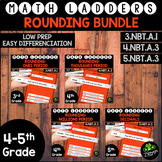
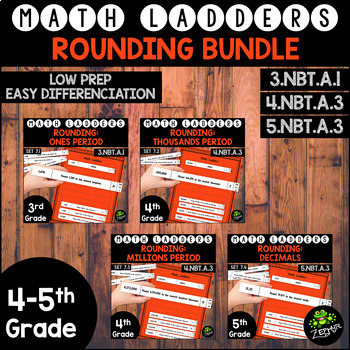
Rounding - Sets 7.1-7.4 {Math Ladders Bundle}


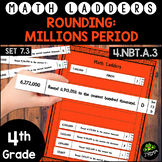
BUNDLE: Rounding Numbers - Sets 7.1-7.4 {Math Ladders}My Facebook feed has been blowing up this last week with two things: northerners going back to school and Hurricane Dorian. We went back three weeks ago, but given that we live in FL, a mini "vacation" has been the result of this storm that can't make up his mind where he's headed. Being cooped up in the house has been boring, to say the least. So, with my limited options (Super Mario Bros or Roller Coaster Tycoon), I chose to work on a product my students will be able to use when we get back later this week.

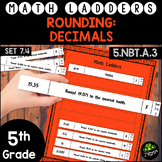
After our first unit, I saw that, as usual, many struggle with rounding. I created these Math Ladders to all be used within my 4th grade class - even though only two hit the benchmark as written for 4th grade, 4.2 & 4.3. My struggling students need to go back to Set 7.1 and revisit rounding with 2 digit whole numbers. My higher students are ready to push forward into the world of decimals (with a place value chart hanging above my white board).
Rounding within the Ones Period -  Set 7.1 {Math Ladders}   Rounding within the Thousand Period -  Set 7.2 {Math Ladders}   Rounding through the Millions Period -  Set 7.3 {Math Ladders}   Rounding Decimals -  Set 7.4 {Math Ladders}   BUNDLE: Rounding Numbers - Sets 7.1-7.4 {Math Ladders}   


Thursday, July 18, 2019

Converting Fractions & Decimals {Task Cards}

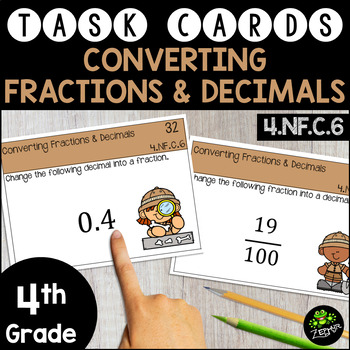
As I was going through my math resources gearing up for another year of 4th grade math, I realized I hadn't created a set of task cards for benchmark 4.NF.C.6.  This benchmark is one that my students, for the most part, pick up on pretty easily - as long as they have that number sense foundation.

Keeping that in mind as I created this set, I designed the first 16 cards to be easily pulled to reteach a small group with those students that hadn't mastered the skill yet. Cards 1-8 focus on converting fractions & decimals in tenths and Cards 8-16 focus on hundredths, exclusively.

Cards 17-32 are mixed for your "on level" students. I would mix in a batch of Cards 1-16 to have a set of 32 cards instead of 16.

And the final 8 cards, Cards 33-40, are challenge cards for your higher learners. These cards are all fractions with denominators other than 10 or 100 and require students to change the denominator to 100 and then make the decimal. For example, students have to convert 1/4 into 25/100 and then 0.25.

Converting Fractions & Decimals {Math Task Cards}


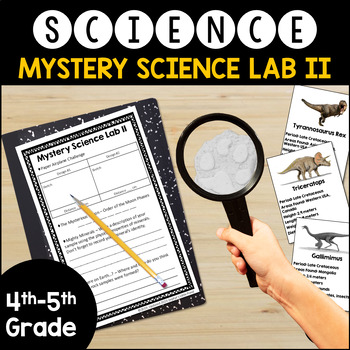
Mystery Science Labs 2

Mystery Science Lab IIBack in college, I stumbled upon/came up with the idea of Mystery Science Labs. Ever since then, I've spent the last few days of the first week of school allowing my students the chance at their first lab.

It's great! The kids get to make some fun observations and handle objects they may or may not have ever seen before. Raccoon tails, gator claws, our live turtle (they don't get to hold/touch Donatello!), plant & animal cell samples, weird looking/smelling rocks & minerals...for many of them it's all new stuff. It's also an introduction into what we'll be learning about this year.

Better yet, I get to observe the kids. I can quickly see if the new kid is fitting in. Or if there are a couple of kids that most definitely should NOT be sitting next to each other, given the amount of horseplay/off task behavior going on. I also get a chance to gauge how well the class is at following directions and how respectful they are when handling materials. They're barely in 4th grade, but I've had groups that handled my materials so carefully and made sure everything was taken care of...and then I've had the flip side of that.

So then, why would I create a second set? Isn't the first set working? 

Well, yes and no.

The first set is great. One of my all-time favorites is The Nose Knows....the smelling station. The kids love that one too and are eager to get to it! But, it's not even remotely related to my benchmarks. I decided to go back and create a whole new set of labs that specifically focus on the benchmarks covered in 4th grade - moon phases; rocks & minerals; and food webs - to name a few.

Now, as they go through this new set of labs, they'll also be given a preview of what is to come for the rest of the year.

If you already have my original Mystery Science Labs and are curious about this one...no worries. There are no duplicate stations between the two.


Thursday, July 4, 2019

Magnificent Desolation: NASA IMAX Movie

I first saw this movie at Kennedy Space Center in the IMAX theater. It. Was. Amazing. My dad, being the biggest supporter of my classroom and a huge space nerd to boot, decided I  needed to have this for the students. After seeing the movie, who was I to argue?? It really is amazing.

We have one lonely benchmark on space exploration in Florida - SC.4.E.5.5. I like to show this movie around this time. It ties in with the Apollo missions and the what-ifs of what could have happened if things had gone wrong.

I like to pose a question to my students: Would you go to the  moon? - and then have them make a t-chart of pros & cons in their notebooks. Their final writing assignment is to make a decision...would they go to the moon? And write their thoughts based on the evidence from the movie.

This is a great way to tie writing in with the science curriculum - and I'm talking about writing that will actually  help them prepare for the 4th grade FSA Writing test. (And if you hang these in the hallway you'll look really good when your principal takes a peek at the writing expectations of your science class!)


Sunday, June 9, 2019

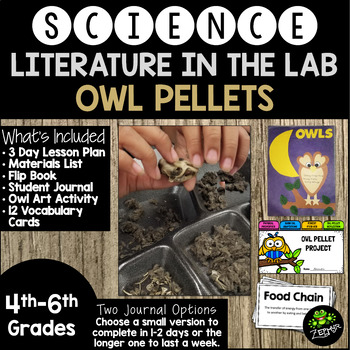
Owl Pellets

So, you want to jump into the world of owl pellets! This is not meant to be a comprehensive unit designed to get your class ready for a test.

This is a fun project for the end of the school year – after testing is over, but before you’re allowed to start showing movies and having all day recess. You know the days….the grade book is closed…you’re working on make up work…and administration still wants you to be doing something academic.

Student engagement usually dwindles down to an all-time low (especially if you’re busy chasing down missing assignments or having kids redo work), but dissecting owl pellets in my room almost always guarantees I have 100% participation. Even from the kids that never want to participate.

The most practical thing about this unit, from a teacher's point of view, is how little you HAVE to be involved. You'll need to give instructions, obviously, but since you've taught students how to find the physical properties of matter (mass, measurement, etc), you don't have to stand over them as they do this. When it comes to opening the pellet, I start out with a video so the students get background on exactly what a pellet is and how it's formed. (This is a good one from You Tube,  if you decide not to order the DVDs.)

You may consider writing a grant through Donors Choose, especially to get the DVD and posters. In the past, I’ve had students bring in a couple of dollars for their pellets, but I’ve found that writing a Donors Choose grant to pay for the grade level makes it easier to guarantee that everyone gets to participate.

Owl Pellets {Literature in the Lab}


Sunday, May 5, 2019

Teacher Appreciation SALE

It's that time of year again! TPT is putting their site on sale Tuesday and Wednesday of this week.


Friday, April 19, 2019

What's in your Science Center???

I was once told that anyone should be able to tell what I teach just by glancing around my room. That person was in charge of deciding what we were going to be teaching as we discussed departmentalization for the next year and I was terrified I'd land with reading all day. Luckily, she was using my room as an example...it was covered in solar system things at the time. :D But, it's something that I've held to...we really should have things out to get the kids' attention for our subject areas.

Last summer I really focused on what I wanted my room to look like. One area was my science center. I've always had one, but it didn't have a purpose until last year. The way the kids used it was completely different compared to previous years. Plus, I was able to keep things fresh with minimal work for me (during the year). 

Now, one thing to note, we have little down time in my class. I wasn't looking for a center that they'd actually rotate to or spend a lot of time in during class. I knew kids wouldn't have time to work on a project and finish it or come back to it the next day (3 rotations of science....I wasn't going to have half-finished projects for 66 kids laying around my room for a month). This set up is for grabbing a few minutes here and there - especially those few minutes before school and during bus duty after school.

I figured out some basics and then made everything fit for the nine weeks. I also only changed them out each quarter - yep, only 4 times a year.
  • Posters: I use the space above the center to display posters for the current quarter. I use a black background and rarely change it (we're talking about once every two years....due to fading). I do change out the border and posters. A secret I discovered....put your second quarter border up first and then use a larger border for first quarter over it. Staples go through and you can just pull the top layer off. I do the same for the posters if I can find some that are the same size. Now, you are damaging the border & posters with two sets of staples, but the time it saves me is worth it. 
  • Task Cards: I printed the Science Penguin's Task Cards sets, hole punched one corner, and put them on the bulletin board near the bottom within kids' reach. I store the unused sets in a container under the center. They're really easy to set up for the next nine weeks.
  • Books: I pick up a bunch of books from the library on the topics we'll be studying. I display them either by setting them up neatly or keeping them in a plastic bin on the center - depending on how much space I have.
  • Observation Items: I have at least one thing for students to observe. All items are kept on the same shelf (or shelves) in my office, so they're easy to get to and put away.
    • Physical Sciences: I put out a basket of random items (sea sponges, coral, shells, coquina, turtle's shell, alligator's claw, raccoon's tail) and things for them to observe/measure with (hand lens, pan balances, rulers, spring scales, etc).
    • Space: I have a model of the solar system that can be moved and a Moon in My Room for them to "play" with. And then there are the sets of model rockets I've picked up from Kennedy Space Center that they love to look at and read about. An inflatable astronaut, space shuttle, and Saturn V rocket round out the center.
    • Earth Science/Rocks & Minerals: I have rock & mineral sets. I also bring out my dinosaur stuff at this time because it doesn't fit anywhere else in our curriculum and this chapter falls right about crunch time for getting ready for state testing. The kids eat up those dinosaur books and the reading teacher loves that they're reading nonfiction. And, it's fun. :) For the observation...I have an inflatable globe that shows what dinosaurs were native to each area of the planet.
    • Life Science: Easily my favorite and the simplest. I have managed to acquire several aquariums through Donor's Choose grants. In them, I keep critters to depict complete & incomplete metamorphosis: tadpoles, monarchs, grass hoppers, and lady bugs are routinely found there.
  • Hands On: I try to have at least one hands on activity, but sometimes don't. The Life Cycles center is too crowded with just the aquariums. At the beginning of the year, I have a Robot Turtles Board Game & Snap Circuits. I paid $8 a piece at a 2nd hand kid's shop for them - both were brand new. Check out Goodwill or the second hand shops around your town for games like this. Legos are great for your center too!! You can buy bulk sets of wheels for legos off of ebay or get some small generic brand packs at Dollar Tree. Generic brand usually work just fine. I also like to throw a couple of cans of Play-Doh in there once I teach the kids how to use it - for models, not to make hamburgers (unless it's indoor recess time and I get to stay out of FL's August heat...then, make all the hamburgers you want).

Organizing It: I actually created a Google Task list and made a section for each quarter with the items I wanted in my center. On our teacher work days before the next quarter, I peek into the list and quickly change out the items. Other than running to the library, it takes less than 10 minutes to change out. And a lot of times, I'll just pick up the books the next time I take the kids to library.

Note: Please ignore the crazy monkeys and palm trees. Those are for my Survivor Test Prep Unit.