Tuesday, July 22, 2025

Math Centers to Prep Now for a Stress-Free Back-to-School

Math Centers to Prep Now for a Stress-Free Back-to-School

Let’s be real—those first few weeks of school are chaaaaaa-oooos. Between setting up your classroom, getting to know your new students, and attending all the meetings, there’s barely time to plan, let alone prep new materials.

That’s why summer is the perfect time to get ahead—especially when it comes to your math centers.

Spending a little time now printing, laminating, and organizing your go-to math games and activities means one less thing to stress about when August hits. You’ll walk in feeling ready, with hands-on centers your students will actually enjoy.


🧩 Why Prep Math Centers Over the Summer?

Here’s the deal—having a few centers ready to go at the start of the year gives you:

  • Peace of mind (because you're not scrambling)

  • More time to focus on your students

  • Fun, meaningful practice from day one

No last-minute printing. No rushed prep. Just grab-and-go math goodness.


🖨️ Print, Laminate, Relax: Centers Worth Prepping Now

If you’re looking for centers to knock out now and use all year long, here are some favorites that are easy to prep and totally worth it:

✨ Place Value Review Center

Place value is always one of those skills that needs refreshing early in the year. This center includes  task cards with a variety of types of questions —perfect for small groups or rotations.

✨ Go Fish Math Games

Yes, your students can actually play Go Fish and learn something! These card games cover:

  • Fractions, decimals, and percents

  • Whole number operations

  • Comparing decimals

Tip: Print a few versions on colored cardstock so sets don’t get mixed up. Laminate and you’re good for years.


✨ Early Finisher Task Cards

Having something ready for your fast finishers is a game-changer. These cards give students meaningful review without constant direction from you.

Summer Tip: Hole-punch and put them on binder rings, or sort them into labeled photo boxes. Easy to grab when you need them!


✨ Seasonal Centers

Sure, fall feels far away—but October sneaks up fast once school starts. Prepping a few themed centers now (think pumpkins, turkeys, or Christmas math) means you won’t be scrambling later. Pair these games boards with any set of task cards & you're ready to go.


Summer Tip: Store these in monthly bins or folders so you can grab them when the time comes—no last-minute prep required.


✅ Summer Center Prep Checklist

Here’s a quick to-do list to keep you on track:

Print your centers
Laminate & cut
Label bags, bins, or boxes
Add direction cards for independence
Store by skill or season

☕ Bonus Tip: Center Prep = Social Hour

Turn on a podcast, invite a teacher friend over, or prep while watching your favorite show. It doesn’t have to be boring—make it your version of productive self-care!


Start the Year with One Less Thing to Worry About

When your math centers are already prepped, you’ll walk into your classroom feeling a whole lot more ready. You can focus on your students, your routines, and building a classroom community—without stressing about what they’ll do on Day 3.
Thursday, June 12, 2025

Last Week of School Science Activities

Wondering how to make the last days of school memorable?

Check out my Mystery Science Labs II - an intriguing set of mini-labs centered around Florida 4th Grade benchmarks needed for the 5th Grade Science FCAT. Mystery Science Labs III is a mini set of labs for a shorter class period. The original set of Mystery Science Labs contains 11 mini exploration stations to help students explore the world around them and apply their powers of observation.

Or maybe you want to jump into the world of owl pellets! This product is not meant to be a comprehensive unit designed to get your class ready for a test. This is a fun project for the end of the school year – after testing is over, but before you’re allowed to start showing movies and having all day recess.

Then again, you might be trying to collect make up work from a couple of students and need to keep the rest of the class busy while doing so. Try letting the rest of the class create their own investigation using magnets from your physical science kit and using the free template below.

Tuesday, June 10, 2025

Math Games to Make the Last Days Count!

Looking for a way to keep students engaged (and learning!) during those final days of school? I’ve got you covered with low-prep, high-impact math games that review key skills while keeping the energy positive and productive!

Go Fish: Turn review into fun with themed Go Fish sets.

  • Fractions, Decimals, and Percents
  • Whole Numbers
  • Decimals
  • Measurement
  • Fact Families

Factor Frenzy & Multiple Madness: Perfect for practicing factors and multiples—fast-paced and easy to set up!

Bingo: Review decimals and place value in a format students already love. Great for small groups or whole class!

Long Division Games: Turn long division into a themed-challenge.

Dominoes: Get students matching and comparing.

  • Fractions, Decimals, and Percents
  • Equivalent Fractions

These games are great for centers, partner work, early finishers, or a fun math review day. Keep your students sharp while winding down the year in a meaningful way!

Wishing you a smooth and happy end to the school year!

Tuesday, February 11, 2025

Exploring Mineral Properties: A Hands-On Activity for Hardness

Learning about the hardness of minerals provides an exciting opportunity for students to practice scientific testing and observation. This hands-on activity introduces students to the concept of mineral hardness and how it helps identify different minerals. Using a simple series of scratch tests, students will sort their samples into categories and record their findings, all while deepening their understanding of this key mineral property.

Start the lesson by watching the video clip on mineral hardness, which explains how some minerals can be easily scratched by a fingernail, while others are much harder and resist scratching altogether. Use this as a discussion starter, asking students why hardness might be an important characteristic in identifying minerals. 

After the discussion, students will test the hardness of their mineral samples by following a sequence of scratch tests. First, use a fingernail to try to scratch the surface of the mineral. If the sample is scratched, place it in the Soft column and do not test it further to avoid damaging the sample. Next, test the remaining samples with a penny. If the penny scratches the mineral, place it in the Medium column. For those not scratched by the penny, use a steel nail. Minerals scratched by the nail belong in the Hard column. Any samples that cannot be scratched by any of the tools can be categorized as Very Hard.

As students work, have them record their observations on the Mineral Properties Recording Sheet, noting the tools used and the results of each test. This systematic approach not only teaches the concept of hardness but also reinforces the importance of careful observation and accurate data recording. By engaging in this activity, students gain a hands-on understanding of mineral hardness while applying scientific methods in a fun and interactive way!

Using Boom Cards for Review

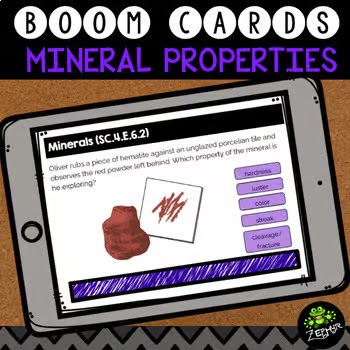
Enhance your students’ understanding of mineral properties with my Boom Cards, designed to make review both interactive and effective. These self-checking digital task cards are perfect for preteaching key concepts, helping absent students catch up, or offering extra practice for those who need it. Whether in the classroom or at home, they provide a fun and accessible way to reinforce learning and build confidence.

Wrapping Up

If you’re planning to teach about mineral properties, I’ve created sorting mats to help students take their learning further by categorizing and analyzing mineral samples. These mats are a valuable resource for any classroom and can be downloaded below. By incorporating hands-on activities, students can connect theoretical knowledge to real-world examples, making mineral properties more engaging and meaningful. This activity is a fun and educational way to bring science to life, and I highly recommend giving it a try with your class!


Sunday, February 9, 2025

Weathering with Conversation Hearts: A Sweet Science Experiment


Understanding weathering—the process that breaks down rocks into smaller pieces over time—is a fundamental concept in earth science. With this simple and engaging experiment, students can observe mechanical weathering in action using Conversation Hearts candy. This hands-on activity is perfect for demonstrating how rocks break down due to physical forces like wind, water, and abrasion.

Materials Needed:

  • Conversation Hearts candy (or any small, solid candy)

  • Small container with a lid (such as a plastic food storage container)

  • Small pebbles or aquarium gravel

  • Paper and pencil for observations

Procedure:

  1. Initial Observations: Give each student a few Conversation Hearts. Have them examine the hearts carefully, noting their shape, color, and any imprinted messages. Students can record their observations in a science journal.

  2. Simulating Weathering: Place the Conversation Hearts in the container along with a handful of small pebbles or aquarium gravel. Secure the lid tightly. Instruct students to shake the container vigorously for about 30 seconds to 1 minute. The pebbles act like natural forces such as wind and water that cause rocks to collide and wear down over time.

  3. Observing Changes: After shaking, pour out the Conversation Hearts onto a tray or paper towel. Have students observe and record how the candy has changed. They should notice that the edges may have softened, colors may have faded, and small fragments may have broken off.

  4. Discussion and Connection to Weathering: Discuss with students how this experiment models mechanical weathering. Explain that, just like the candy pieces breaking down due to friction and impact, rocks in nature are weathered by physical forces like flowing water, wind, and ice.

Extension Ideas:

  • Time Variation: Have students shake the container for different lengths of time and compare results.

  • Different Materials: Try using different types of candy to see if some weather faster than others.

  • Real-World Connections: Show images of weathered rock formations, such as smooth river stones or eroded cliffs, to help students connect their observations to real geological processes.

This simple yet effective experiment brings an abstract concept to life in a way that’s engaging and memorable for students. Plus, it’s a great excuse to use some extra candy after Valentine’s Day!

Need a review activity? Check out my Science Boom Cards - a no prep, self-checking digital activity for students to use either in the classroom (fast finishers) or at home for extra study time.


Tuesday, February 4, 2025

Exploring Mineral Properties: A Hands-On Activity for Streak

Understanding the streak of a mineral is a fascinating way for students to explore its unique properties and practice scientific observation. This hands-on activity guides students through performing streak tests on their mineral samples, using video instruction to enhance their learning. By combining visual aids and interactive exploration, this activity helps students grasp the concept of streak while honing their observation and recording skills.

Streak

Start by introducing the concept of streak with the video clip included in the resource. Use this as a discussion starter, emphasizing that a mineral's streak is the color of the powder it leaves behind when scratched across a streak plate. Unlike the mineral's external color, its streak provides a more consistent clue to its identity. Highlight that some minerals, like pyrite (fool’s gold), can have a streak color that differs significantly from their outward appearance.

To perform the streak test, ensure the classroom is equipped with both white and black streak plates. Having both types allows students to easily see the powder trail left behind, especially for lighter or darker minerals. After watching the video, students will carefully rub their mineral samples across the plates, noting the color of the streak in their Mineral Properties Recording Sheet. Remind them to handle the plates gently and to test each mineral on both colors to ensure accurate observations.

This activity not only teaches students about streak as a reliable mineral property but also underscores the importance of hands-on learning and scientific inquiry. By encouraging discussion, careful testing, and accurate recording, teachers can foster curiosity and critical thinking in their students—key skills for budding geologists and scientists.

Using Boom Cards for Review

To help students review the properties of minerals, try using my Boom Cards for an interactive and engaging experience. These self-checking digital task cards are ideal for preteaching concepts, helping absent students catch up, or providing extra practice for those who need it. Whether used in the classroom or at home, they offer a fun and effective way to make learning accessible for all students.

Wrapping Up

If you’re planning to teach about the properties of minerals, I’ve designed sorting mats to help students dive deeper into categorizing and analyzing their mineral samples. These mats are an excellent tool for hands-on learning and can be downloaded below to enhance your lesson. By actively engaging with real-world examples, students can bridge the gap between theoretical concepts and practical application, making the study of mineral properties more meaningful. This activity is not only educational but also a fun and memorable way to bring science to life in your classroom!