Sunday, April 21, 2024

Engage Your Students with Math Ladders: A Fun Classroom Strategy for Differentiation


Are you searching for a dynamic way to cater to the diverse learning needs in your classroom? Look no further than Math Ladders! This versatile tool offers a single skill on various levels, simplifying differentiation for educators like you. Here's how you can incorporate Math Ladders into your classroom routine for an engaging and effective learning experience.

1. Easy Differentiation Each Math Ladders packet contains a single skill presented at different levels. This feature makes it a breeze for teachers to differentiate instruction based on individual student needs. With the table of contents at your fingertips, simply assign students to the appropriate level, ensuring they receive targeted practice at just the right challenge level.

2. Horizontal Problem Layout One unique aspect of Math Ladders is the horizontal layout of problems. Students must line up the digits correctly as they solve each problem, adding an extra layer of accountability to their work. This format encourages attention to detail and reinforces mathematical accuracy, setting students up for success in mastering the skill.

3. Interactive Gameplay Engage your students in active learning with Math Ladders gameplay. To begin, students solve the problem on the START card. They then locate the corresponding answer on the left side of another card and place it above their original problem. This process continues as they work their way up the ladder, solving each new problem until they reach the top FINISH card. The interactive nature of this activity promotes critical thinking and problem-solving skills while keeping students motivated and focused.

4. Setting Up as a Center Math Ladders can easily be implemented as a center activity in your classroom. Simply follow these steps to set up:

  • Print game boards for each student at the center.
  • Print enough sets of cards for each student, cut them apart, and keep them in snack-sized baggies for easy distribution.
  • Provide each student with an answer sheet for recording their answers.
  • Optionally, print one answer key to keep at the center for students to check their work.

Alternatively, you can print a class set of game boards and cards and have students cut and paste their assignments. This flexibility allows you to customize the activity to suit your classroom setup and preferences.

Incorporating Math Ladders into your classroom routine not only supports differentiated instruction but also fosters a collaborative and engaging learning environment. Whether used as a center activity or a whole-class assignment, Math Ladders are sure to inspire your students to climb to new heights in their mathematical proficiency. So why wait? Take your classroom to the next level with Math Ladders today!

Check out 2 free sets below.


Interested in building your library?
(Individual sets linked within the bundles.)


Sunday, March 24, 2024

✨5 Reasons You Need Boom Cards in Your Classroom✨

 I love using Boom Cards in my classroom! They're a fantastic tool for helping my fourth graders grasp science concepts and for giving my fifth graders a fun way to review what they learned last year.

Why I Love Boom Cards...

  1. Interactive Learning: Boom Cards offer interactive learning experiences, engaging students in a way that traditional methods often cannot.
  2. Immediate Feedback: Boom Cards provide immediate feedback to students, helping them identify and correct mistakes in real-time, which can accelerate the learning process.
  3. Self-Paced Learning: Students can progress through Boom Card decks at their own pace, allowing for individualized learning experiences and accommodating varying levels of proficiency.
  4. Data Tracking: Boom Cards come with built-in data tracking features that allow teachers to monitor students' progress and identify areas where additional support may be needed.
  5. Remote Learning: Students have the flexibility to utilize Boom Cards at home, whether it's for additional practice or to catch up on missed lessons during extended absences. (And with flu season upon us, this has been my top reason over the last few weeks!)

Check out all of my Science Boom Cards covering 4th grade standards.
(Great for 5th Grade Review before the Science FCAT.)

store post

Saturday, March 23, 2024

April 8 Solar Eclipse

On April 8th, a stellar display will unfold in the skies — a solar eclipse, where the moon passes between the Earth and the sun, temporarily blocking out its light. For elementary school students, witnessing such an event can be a memorable and educational experience. I can still recall viewing a partial solar eclipse with my class when I was in pre-k.

Understanding Solar Eclipses: A solar eclipse occurs when the moon aligns perfectly between the Earth and the sun, casting a shadow on the Earth's surface. During a total solar eclipse, the sun appears completely covered by the moon, creating a brief period of darkness known as totality. Partial solar eclipses occur when only part of the sun is obscured by the moon. These celestial events offer a unique opportunity to observe the intricate dance of the sun, moon, and Earth in motion.

Exploring the Path of Totality: The April 8 solar eclipse will be visible in North America, with regions along the path of totality experiencing the most dramatic effects. While not everyone will have the opportunity to witness the total eclipse in person, all of the 48 lower states will be able to observe at least a partial eclipse.

Activities for Elementary School Students

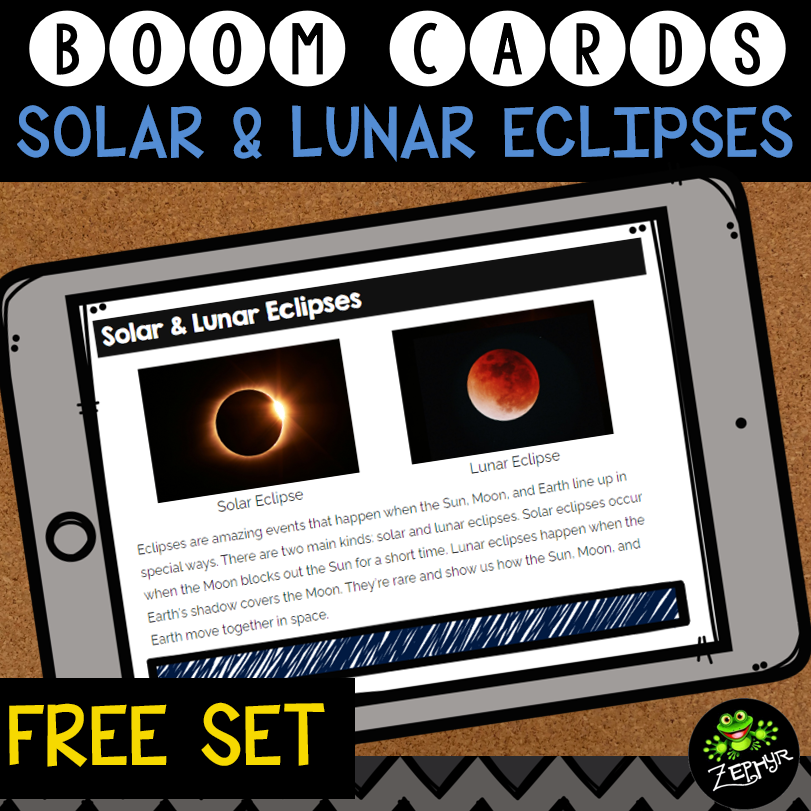
  • FREE Boom Cards: Check out the free set of Boom Cards in my store to introduce your students to the concept of solar & lunar eclipses. This set includes information, a map for the 2024 eclipse, and 2 sorting activities.
  • Solar Eclipse Model: Create a simple model to demonstrate how solar eclipses occur. Use a flashlight to represent the sun, a ball for the Earth, and a smaller ball or coin for the moon. Have students experiment with different arrangements to simulate the alignment of the sun, moon, and Earth during an eclipse.
  • Pinhole Viewer: Teach students how to safely observe a solar eclipse using a pinhole camera. Encourage them to experiment with different sizes of pinholes to achieve the clearest image of the eclipsed sun. Check out NASA's instructions for creating a pinhole viewer.
  • Eclipse Art: Inspire students to express their creativity through eclipse-themed art projects. Provide materials such as black construction paper, chalk pastels, and white chalk to create striking images of the sun, moon, and Earth during an eclipse. Encourage students to research different artistic interpretations of solar eclipses for inspiration.
  • Eclipse Viewing Party: Host a viewing party for students to watch the solar eclipse. Eclipse viewing glasses can be purchased off several websites. (I would suggest requiring a permission form be signed by parents.) Create a festive atmosphere with eclipse-themed snacks, music, and decorations. Turn this into a writing activity by encouraging students to keep eclipse journals to record their observations and reflections during the event.


Thursday, March 21, 2024

Spice Up Math Class with Games!

With spring break coming up, let's add some fun into our math lessons to keep the energy up until the break. And what better way to do that than with games? Here's why adding games to our math class before the break is a good idea:

  • Engagement: Games grab students' attention and make math more enjoyable. They're a great way to keep everyone interested and involved.
  • Learning Made Fun: Math games turn learning into a fun activity. Whether it's Decimal Bingo or Fraction, Decimals, & Percents Go Fish, they make practicing math feel like a game rather than work.
  • Teamwork and Communication: Games encourage teamwork and communication among students as they work together to solve problems or win the game.
  • Motivation: Games motivate students to participate and do their best. The element of competition can drive them to excel in math.
  • Review Time: With spring break around the corner, it's a good time to review key math concepts. Games provide a stress-free way for students to review what they've learned.

See all math games in my store.

So, let's spice up our math class with some games and make the most of the time we have before spring break!

store post